

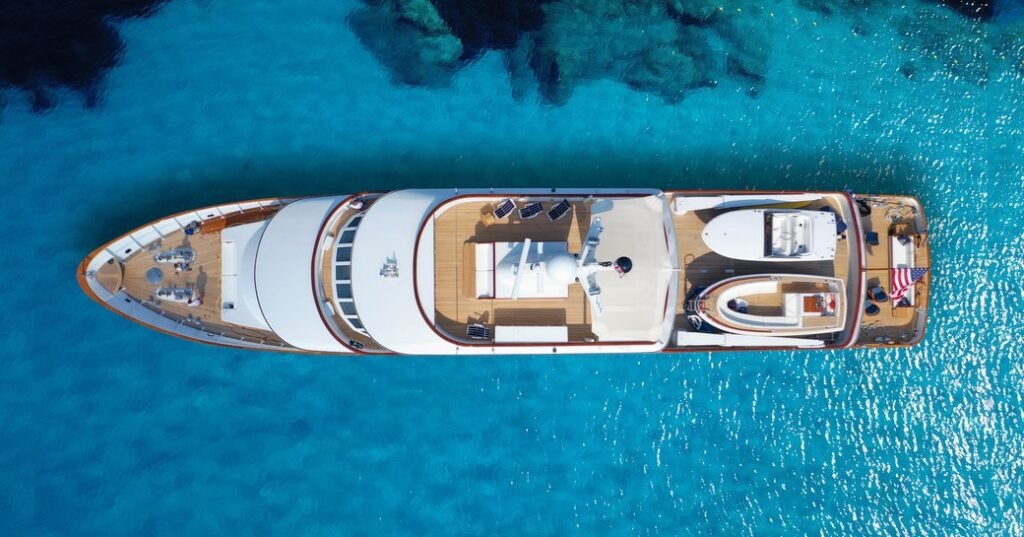
On 1 May 2024 the threshold for carrying a Garbage Record Book dropped from 400 gross tonnage to 100. In practice that is roughly the difference between a 45-metre yacht and something closer to 28 — and it brought a large part of the fleet into scope more or less overnight. If nobody aboard has looked at this since 2023, it is worth ten minutes.
This sets out what MARPOL Annex V actually requires: who needs a book, what goes in it, who signs it, and how long it stays on board. Where something is a legal requirement, we say so. Where it is our own recommendation from supplying yachts, we say that instead.
Does your yacht need one?
Legal requirement. Under MARPOL Annex V, a Garbage Record Book must be carried by:
- every ship of 100 gross tonnage and above
- every ship certified to carry 15 or more persons on voyages to ports or offshore terminals under the jurisdiction of another Party to the Convention
- every fixed or floating platform
The 100 GT figure is new. It was 400 GT until resolution MEPC.360(79), adopted on 16 December 2022, entered into force on 1 May 2024.
Two things follow for yachts in particular.
First, the fifteen-persons test catches vessels well under 100 GT. A charter yacht certified for 12 guests and 6 crew is carrying 18 people. It needs a book whatever the tonnage says.
Second, under 100 GT is not the same as exempt. Smaller vessels must still record any discharge or accidental loss of garbage — the entry goes in the ship’s official logbook rather than a separate Garbage Record Book.
The nine categories
Legal requirement. Garbage is classified by letter. Part I of the book applies to all ships:
| Code | Category |
|---|---|
| A | Plastics |
| B | Food wastes |
| C | Domestic wastes |
| D | Cooking oil |
| E | Incinerator ashes |
| F | Operational wastes |
| G | Animal carcasses |
| H | Fishing gear |
| I | E-waste |
Part II covers cargo residues and applies only to ships carrying solid bulk cargoes, so it will not concern a yacht.
Two of these routinely catch people out. Cooking oil has its own category — galley oil is not domestic waste. And e-waste has its own category, which on a modern yacht means retired AV equipment, laptops, phones, batteries and control panels, not just obvious electronics.
What has to be recorded
Legal requirement. Four kinds of event go in the book:
- Discharge into the sea
- Discharge to a port reception facility ashore
- Incineration on board
- Accidental loss or discharge
For each one, record the date, time, the ship’s position, the category of garbage, the estimated amount, and where it went.
Best practice. Keep the receipts from reception facilities with the book. They are what a port state control officer will compare your entries against, and a book that does not reconcile with its receipts is a worse position than a sparse one.
Who signs what
Legal requirement. Each entry is signed by the officer in charge of that operation. Each completed page is signed by the master.
On yachts this is the detail most often missed, because the person moving the waste and the person signing the page are rarely the same watch.
How long it stays on board
Legal requirement. MARPOL requires the Garbage Record Book to be kept aboard for two years after the date of the last entry.
Check your flag. Some administrations require longer — the Bahamas Maritime Authority, for example, specifies three years. Two years is the floor, not necessarily your obligation. Read your own flag state’s marine notice rather than assuming.
The two things people forget
Legal requirement. A Garbage Record Book is not the whole obligation.
A Garbage Management Plan is required for ships of 100 GT and above and ships certified to carry 15 or more persons. It sets out written procedures for minimising, collecting, storing, processing and disposing of garbage, names the person responsible, and must be in the crew’s working language.
Placards are required on every ship of 12 metres or more in length, telling crew and passengers what the discharge requirements are. That threshold is low enough to cover effectively every superyacht, tender included.
What may legally go over the side
Legal requirement. The starting position is that discharging garbage into the sea is prohibited. Plastics may never be discharged — anywhere, under any circumstances.
Narrow exceptions exist, chiefly for comminuted food waste at a distance from the nearest land, and for animal carcasses. The permitted distances and conditions vary, and Special Areas are stricter again.
Yacht Trash recommendation. Do not make a discharge decision from a blog post, this one included. Work from your Garbage Management Plan and your flag state’s guidance, and when there is any doubt, land it ashore. The cost of landing waste is trivial beside a port state control detention.
Fewer entries, less to get wrong
Yacht Trash recommendation, from supplying yachts. Every landing is an entry, and every entry is a chance for the book and the receipts to disagree. The most reliable way to keep record keeping simple is to have less waste to move in the first place.
Two things do most of the work.
Compress before you store. Most of what a bin bag contains is air. If the yacht already runs a Marinaught vacuum system, it draws that air out and heat-seals the bag, cutting the volume by roughly 70%. We supply the bags for it, not the machine. A sealed bag also holds odour and liquid in — which, in a lazarette in August, matters more day to day than any regulation does. The consumable is a 100-litre food-grade vacuum bag.
Deal with glass on its own. Glass is heavy, bulky, and the worst use of locker space on a charter yacht. A glass crusher reduces bottles to sand, which stores in a fraction of the space and is far easier to land.
Neither changes what you are required to record. Both reduce how often you are recording it, and how much of the boat you give up between landings.
Sources
- IMO — Prevention of Pollution by Garbage from Ships
- Lloyd’s Register — Extension of Garbage Record Book requirements (MEPC.360(79))
This article explains the requirements in general terms. It is not legal advice, and it does not replace your flag state’s guidance or your own Garbage Management Plan. For a broader overview of how the rules apply on board, see our guide to MARPOL waste management requirements on superyachts.
Storing more waste than you have room for? Tell us what the yacht runs and how long between landings, and we will come back with a price and a delivery date. Request a quote.